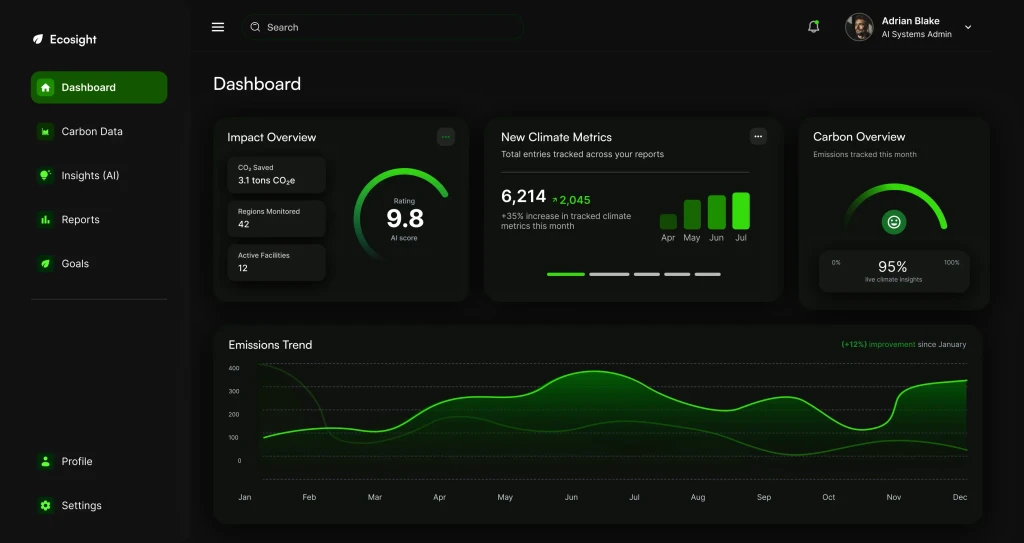
Why dashboards outperform spreadsheets
Manual files slow teams down. Learn why centralized dashboards are becoming the core of modern climate reporting.
2 min read
Nov 18, 2025

Spreadsheets break under real operational complexity
Most companies start climate tracking in Excel or Google Sheets. It works at first — until teams scale, data grows, and more people need access. Then the problems appear:
Version conflicts lead to inconsistent numbers
Manual entry increases the risk of errors
Updating multiple sheets becomes a full-time job
Teams lose trust when sources don’t match
Climate reporting requires accuracy and speed. Spreadsheets provide neither.
They simply weren’t built for high-frequency, operational climate data.
Dashboards create a single, reliable source of truth
A unified climate dashboard centralizes everything — emissions, energy usage, facility data, AI insights — into one clean platform.
This gives teams:
Real-time updates without waiting for monthly manual reports
Instant accuracy checks powered by AI validation
Full visibility across facilities, projects, and regions
Consistent, investor-ready metrics everyone uses
Automatic trend detection so issues don’t go unnoticed
When all your data lives in one place, climate decisions become faster, clearer, and backed by real evidence.
Automation removes human error — and saves days of work
The biggest failure point in spreadsheets is people: copying, pasting, formatting, updating formulas.
A centralized dashboard eliminates this entirely:
Data imports automatically
AI fills gaps and detects anomalies
Reports generate themselves
Teams review insights instead of fixing files
Companies using unified dashboards report up to 3× faster reporting cycles and major reductions in manual workload.
Stay Connected
Follow us for product updates, insights, and climate tech news.